Legal research is one of the most viable applications of AI in practice, but it should be done with caution, as hallucinations in research can turn into work product mistakes. This module covers how AI changes the research process, how to prompt for useful results, and how to verify everything AI produces.
Securities classification
“I represent a Florida client who wants to form a joint venture LLC with a passive investor. The investor will contribute $50,000 for a 10% preferred return but will have no management role. Under the Howey test and Williamson v. Tucker, would this LLC interest likely be classified as a security? Cite the key factors courts consider.”
Federal exemptions
“What federal exemptions under Regulation D allow a private offering to a single non-accredited investor? Specifically, can my client use Rule 506(b) for a real estate JV with one sophisticated but non-accredited investor? What disclosure documents are required?”
Florida state law
“Under Florida Chapter 517, what exemptions apply to a private JV offering? The deal involves a $50,000 investment from a non-accredited investor. I've heard the Limited Offering Exemption has a $10,000 cap for non-accredited investors—is that correct, and what alternatives exist?”
How AI Changes Research
Traditional legal research consists of constructing Boolean queries, scanning results, reading law, refining your search, and repeating until you are confident you have found the relevant authority.
AI-augmented research works differently. Instead of constructing search queries and sifting through results, you describe what you need in natural language.
For example, suppose a Florida real estate attorney’s client wants to enter a joint venture with a non-accredited investor to build and sell a single-family home, offering a 10% preferred return on a $50,000 investment, papered with a JV agreement, promissory note, and mortgage between two LLCs and the client doesn’t want to deal with the SEC.
Under the traditional approach, that single fact pattern would need several distinct research threads requiring their own Boolean queries:
Is the JV interest a security?
("joint venture" "LLC interest" "membership interest") /p security /p (passive "preferred return" "no control" managerial)
Federal exemptions for a non-accredited investor
("Regulation D" "Reg D" "private placement") /p ("non-accredited" sophisticat!) /p exempt!
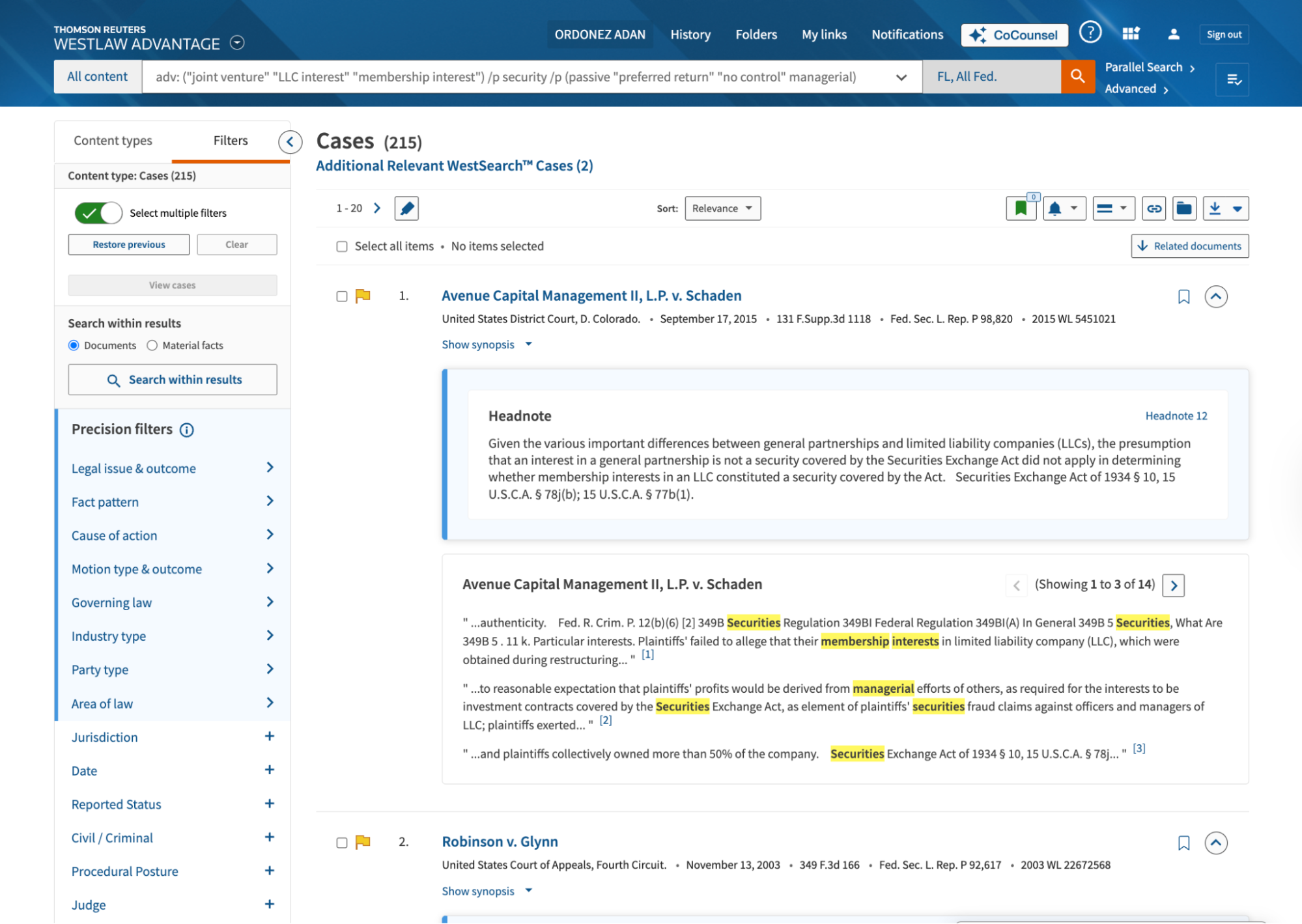
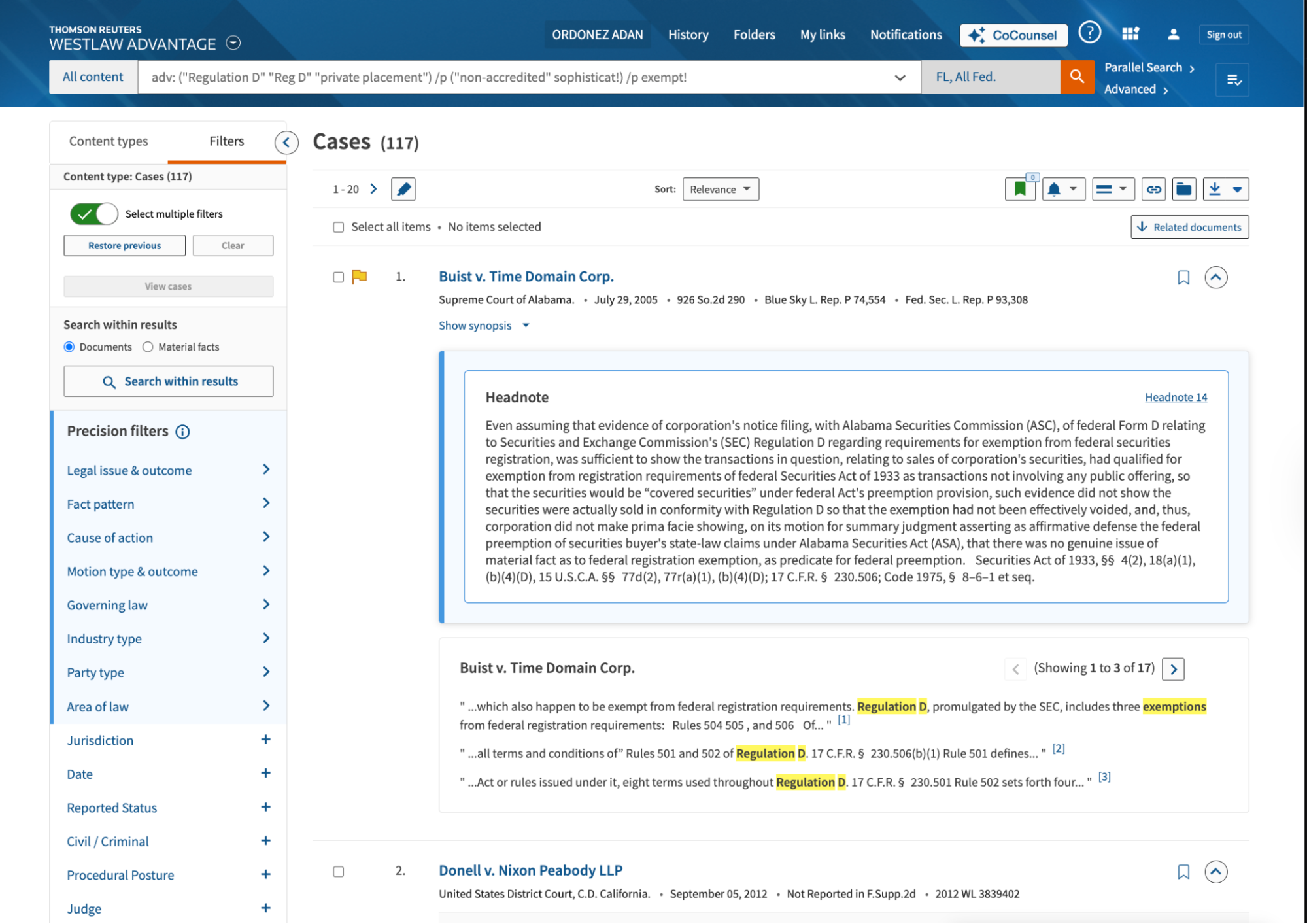
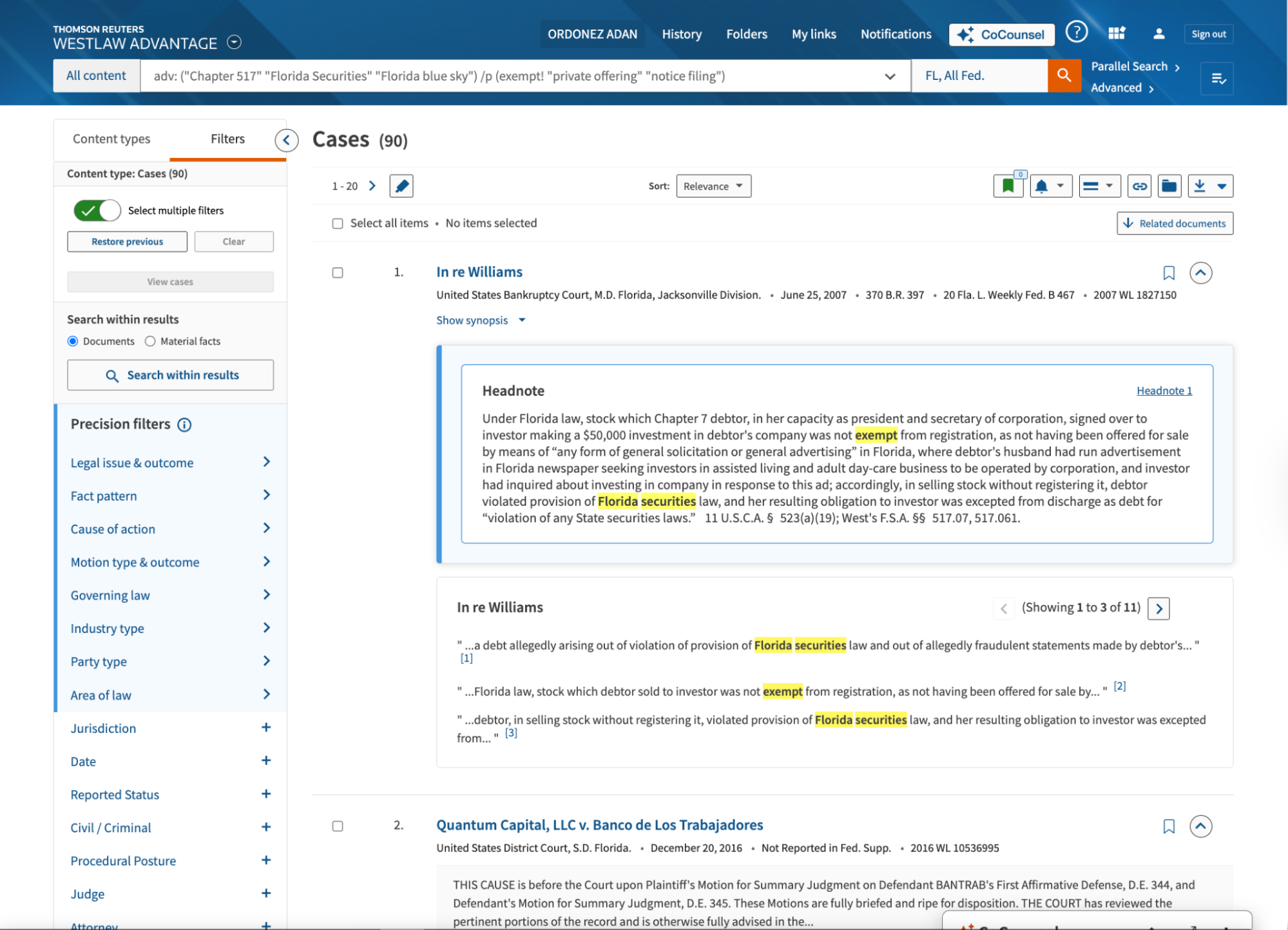
Florida state securities law
("Chapter 517" "Florida Securities" "Florida blue sky") /p (exempt! "private offering" "notice filing")
Results: Lists of 90+ cases, secondary sources, and law review articles, ranked by relevance. The researcher must open each result, skim for relevance, check whether the case is still good law via keycites.
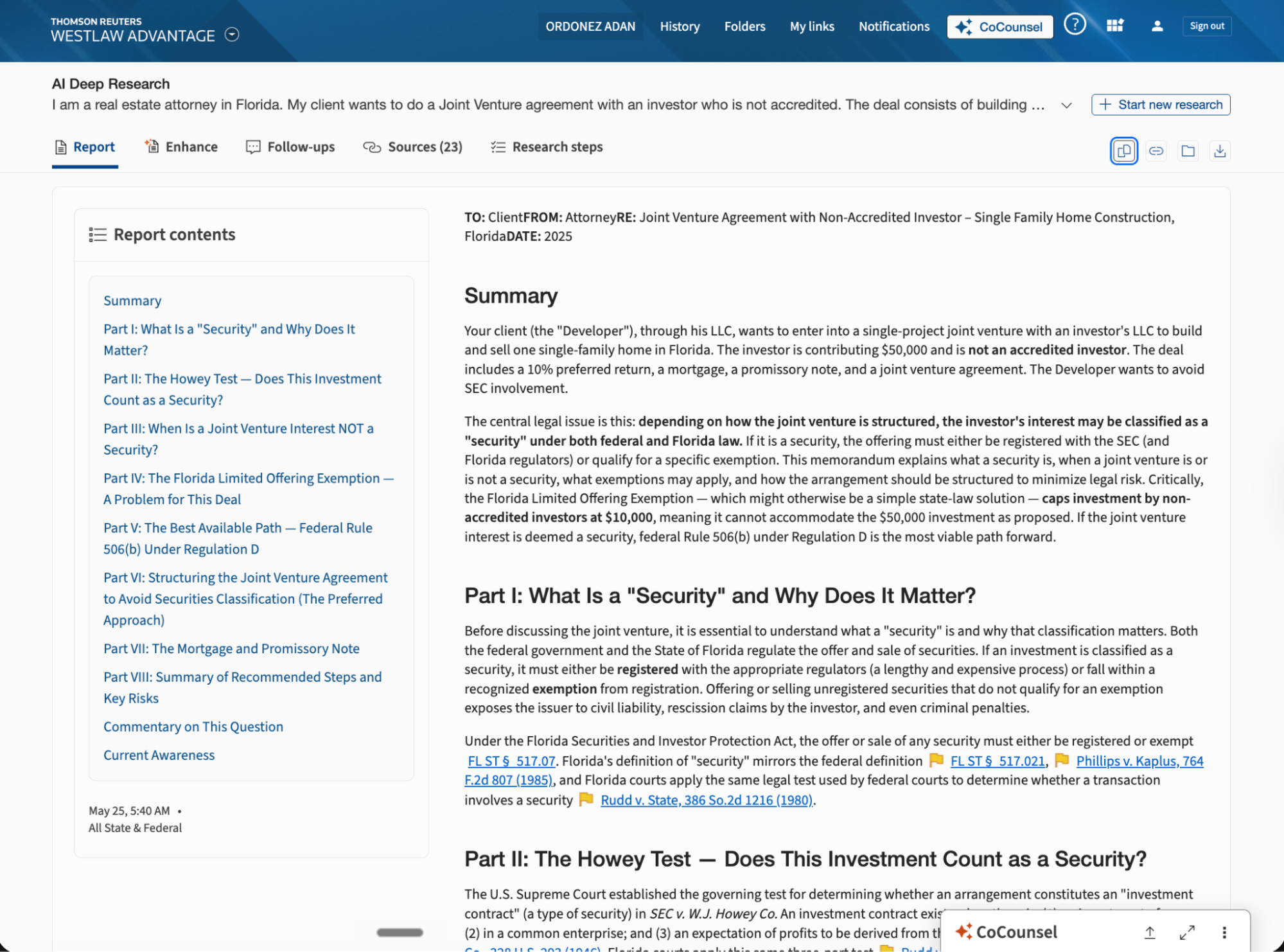
AI, meanwhile, synthesizes information across its training data and generates a structured response in seconds consisting of a legal framework, key cases, relevant statutes, and analysis.
In seconds, the AI returned a structured memorandum covering every issue in the fact pattern:
Is it a security? Applied the Howey test and the Williamson v. Tucker control-rights framework, including the Eleventh Circuit’s application in Youmans v. Simon.
Florida exemption. Flagged that the Florida Limited Offering Exemption is unavailable because the $50,000 investment exceeds the $10,000 cap for non-accredited investors under § 517.0611.
Federal exemption. Identified Rule 506(b) of Regulation D as the most viable path and laid out its requirements: sophistication, mandatory disclosure, no general solicitation, and Form D filing.
Note and mortgage. Analyzed why these instruments are generally not securities when properly documented as a secured loan.
Recommended structure. Proposed giving the investor’s LLC genuine decision-making, inspection, termination, and manager-replacement rights to keep the JV outside securities classification.
Risks and next steps. Closed with a list of key risks and procedural steps, each tied to specific authority including Fla. Stat. §§ 517.07, 517.021, 517.0611, 517.301 and 17 CFR §§ 230.501, 230.502, 230.506.
The bottleneck for each method is different. Traditional research is slower, but once you finish, you are certain of the accuracy because you took the time to look through every source yourself. AI research is much faster at finding sources, but verification consumes some of the time saved.
A trial of 16 experienced open-source developers across 246 tasks found that allowing AI tools made developers 19% slower, even though they perceived themselves as 20% faster. Analyses of the study attribute this largely to verification and review overhead—time spent double-checking AI outputs, understanding changes, and maintaining a mental model of code that developers hadn’t written themselves.
The same pattern appears in legal research. Leading legal-specific AI tools (Lexis+ AI and Westlaw AI-Assisted Research) have been found to hallucinate, meaning that every output requires manual validation, which can erode the apparent time savings.
| Traditional Research | AI-Augmented Research | |
|---|---|---|
| Finding sources | Boolean queries, scanning results, iterating | Natural language prompt, structured response in seconds |
| Verifying sources | You read the sources as you go | Separate step since citation must be independently confirmed |
| Where errors occur | Missed cases, incomplete search | Fabricated citations, mischaracterized holdings |
| What the lawyer does | Searches, reads, analyzes | Prompts, reads, verifies, analyzes |
The most effective workflow uses both: AI for initial synthesis and identification of the relevant framework, and traditional tools for verification and completeness. You let AI do the first pass; then, look at the sources to verify and determine if you need more.
Prompting for Research
The quality of AI research output can depend on the quality of your input. A vague prompt produces vague results, while a specific, well-structured prompt produces something you can work with.
Be Specific About What You Need
For example: “What’s the law on employment discrimination?” will get you an unhelpful generic overview.
Instead, specify the legal question, the jurisdiction, the procedural posture, and the type of authority you need.
“Under Title VII, what is the burden-shifting framework for disparate treatment claims in the Seventh Circuit, and how have district courts in the Northern District of Illinois applied it at the summary judgment stage?”
That prompt produces something useful.
Provide Your Context
Tell the AI who you represent, what position you are taking, and where you are in the proceeding.
“I represent the defendant employer in a Title VII case in the Northern District of Illinois. The plaintiff has moved for summary judgment. I need authority supporting the argument that the employer's stated reason for termination was legitimate and non-pretextual.”
Context shapes the output. Without it, you get a textbook summary. With it, you get targeted analysis.
Vague prompt
What's the law on employment discrimination?
Model output
Employment discrimination law prohibits treating employees differently based on protected characteristics such as race, sex, religion, national origin, age, or disability. Major federal statutes include Title VII of the Civil Rights Act of 1964, the Age Discrimination in Employment Act (ADEA), and the Americans with Disabilities Act (ADA). Claims generally require a prima facie showing...
Why this fails
Generic textbook overview. No jurisdiction, no procedural posture, and no authority you can safely cite.
Require Reasoning and Sources
The cardinal rule for AI-assisted legal research is to never accept a conclusion without the reasoning and sources behind it. Instruct the AI to cite specific authorities for every proposition and to include direct language from the sources it relies on.
If the AI provides a conclusion without a source, treat it as unverified. If it provides a source but cannot point to specific language, that is a signal that the citation may be fabricated.
A useful prompt addition:
“For each case you cite, provide the full citation, the specific holding, and the exact language from the opinion that supports your analysis. If you are uncertain about a citation or cannot locate the specific text, say so rather than guessing.”
Models given explicit permission to express uncertainty do so more often than those not given such permission.
Break Complex Research into Steps
Do not ask one massive question and expect a complete research memo. It’s better to break the research into stages.
First, ask the AI to identify the relevant legal framework and governing standard. Then ask for the key cases or law. Verify those. Then ask for an analysis of how the cases apply to your facts.
Confirm each stage before you build on it. An error caught at an earlier stage will save you a lot of time down the road.
The Verification Stack
Every piece of AI-generated legal research must pass through three layers of verification before it reaches your work product. These layers are described below:
Question
Does this source actually exist?
What it catches
Fabricated cases, statutes, regulations
Common mistake indicators
Flag if citation format looks off, the case is unfamiliar in your practice area, or seems "too perfect" (ideal facts, holding exactly on point)
How to check
Search the citation in Westlaw, Lexis, or Google Scholar
Real example
AI cites "Thompson v. Digital Solutions, 847 F.3d 1123." You enter the citation in Westlaw. It resolves to a different case, or no case at all.
Question
Does it say what AI claims?
What it catches
Mischaracterized holdings, invented quotations
Common mistake indicators
Flag if the AI misstates the holding, confuses a party's argument with the court's ruling, or presents dicta as binding law
How to check
Pull the source; go to the cited page; read the actual language
Real example
AI says a case held that limitation clauses are "presumptively enforceable." You pull the opinion. The court was describing the defendant's argument, not its own holding.
Question
Is the law still good?
What it catches
Overruled cases, amended statutes, superseded regs
Common mistake indicators
Even if accurately described, a case or statute may be outdated (overruled, distinguished, superseded) since the AI's data was compiled
How to check
Use KeyCite (Westlaw) and Shepard's (Lexis) to check for negative treatment
Real example
AI cites Planned Parenthood v. Casey for the undue burden test. KeyCite shows Casey was overruled by Dobbs. Accurate in 2021, but wrong today.
KeyCite — the currency check
Even correctly cited, accurately described cases go stale. Flag every citation before filing.
AI said
The undue burden test governs abortion restrictions.
Citator
Overruled by Dobbs v. Jackson Women's Health Org., 597 U.S. 215 (2022).
Action
Do not cite for the undue-burden test. Cite Dobbs for current standard.
The Scale of the Problem
AI hallucination in legal research is a frequent, well-documented failure that affects every AI tool currently available, including those built specifically for legal work and marketed as reliable.
| Tool | Hallucination Rate |
|---|---|
| General-purpose AI (ChatGPT, Claude, etc.) | Higher than specialized tools (varies by query) |
| Lexis+ AI (best-performing specialized tool) | ~17% of queries |
| Westlaw AI-Assisted Research | ~33% of queries |
Magesh et al., Stanford University / Journal of Empirical Legal Studies (2025).
Although this study was conducted in 2024, the gap between marketing claims and measured performance remains significant. Tools described as “hallucination-free” are not. While the hallucination rates are declining, no tool available today is reliable enough to use without independent verification.
The consequences are accumulating. Over 700 AI hallucination cases have been documented in courts worldwide as of late 2025, with more than 300 in U.S. courts and over 100 lawyers sanctioned. You should always treat verification as a mandatory part of AI usage, just as much as proofreading your own work product before submission.
Building the Habit of Efficient and Responsible AI Use
With AI, verification essentially becomes the research.
The AI generates a starting point, and you turn it into a reliable work product through verification. The time savings come from the fact that checking a structured AI output against actual sources is faster than building that output from scratch.
The workflow is as follows
Prompt
Receive output
Verify existence, accuracy, currency
Create work product
Lawyers who build this habit capture AI’s speed without sacrificing accuracy.